

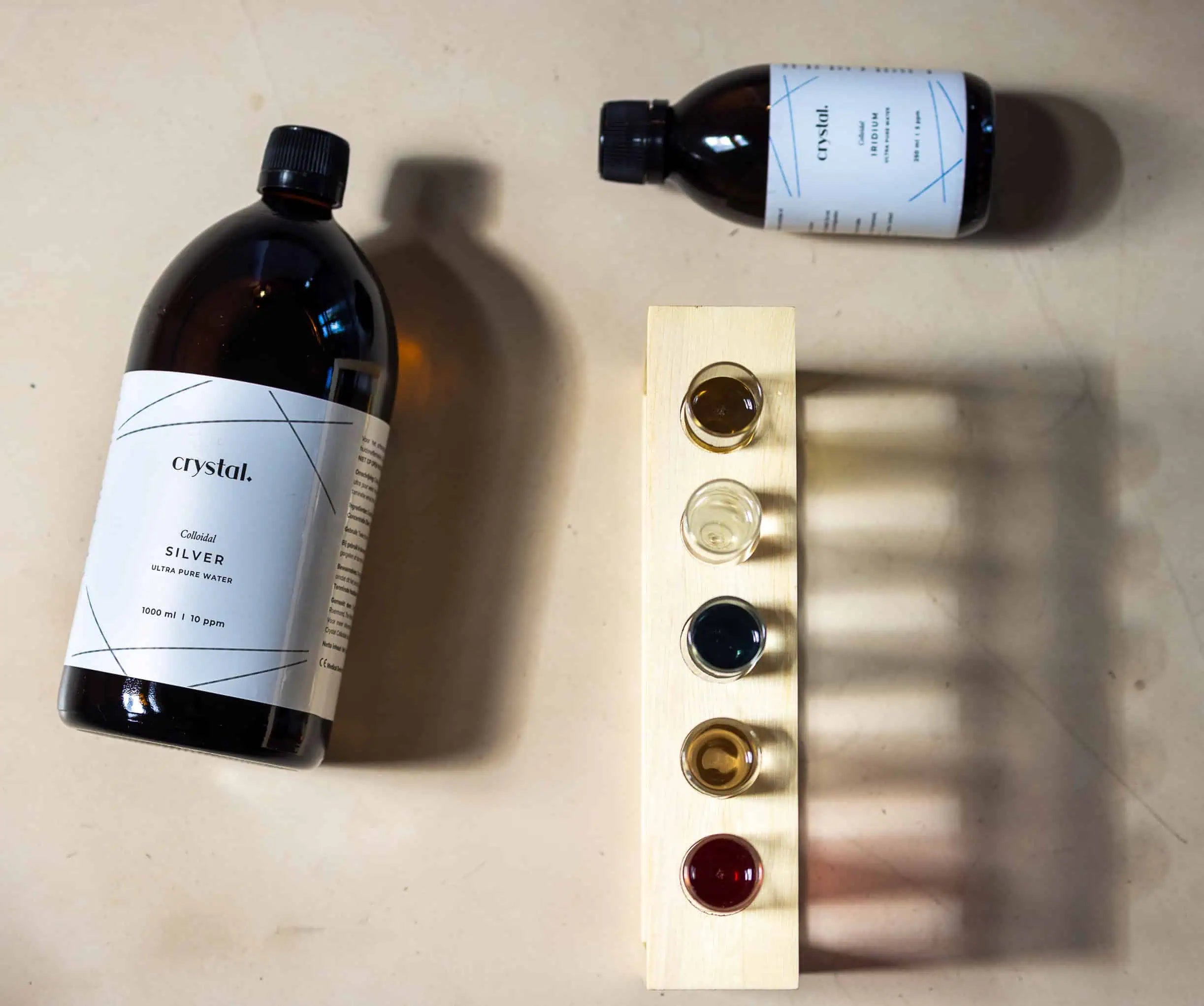
When assessing the quality of a colloidal product, it is important to look at the following factors: particle size, concentration, and total working area. In this article, we explain these in detail, reveal some common myths, and provide real independent laboratory reports to highlight these discrepancies in the market.
Effective working surface
Many people assume that concentration is the best way to determine the quality of a colloidal product. However, this can be quite misleading if other factors are not taken into account. It is like looking at one part of the equation, but not the whole.
First, it is important to understand how the effective working surface is defined and how it relates to concentration.
The effective surface area is defined as the total surface area in centimeters (cm2) of all particles in one milliliter (ml) of a colloid. It is important to note that particle surface area is inversely proportional to particle size; for a constant particle concentration, surface area increases as particle size decreases.
For example, if you have a colloidal solution at 10 PPM with a particle size of 1 nanometer, the total effective working area is 6 m2. If you have the same concentration of 10 PPM, but now the particle size decreases from 1 nanometer to 0.65 nanometers, then the total effective working area increases from 6 m2 to 7.1 m2.
Particles per million (PPM) concentration
PPM stands for parts per million. Concentration is expressed in parts per million and is numerically the same as milligrams of silver per liter of water (mg/l).
The concentration of a colloid is often expressed in PPM. Parts per million, or PPM for short, is the measure of the mass of a chemical, metal, or contaminant per unit volume of water. One PPM is equal to the absolute fractional quantity multiplied by one million.
For example, the following similarities can help you understand PPM better:
- 1 second in 11.5 days
- 1 minute in 2 years
In other words, PPM expresses how many milligrams of our colloidal particles are present in each liter of water. So a colloidal silver product at 10 PPM will contain 10 mg of silver per liter.
The particle surface area for colloids is an extremely important calculation because it determines the overall effectiveness of the product. The particle surface area directly determines the colloid's ability to react with its environment. The conclusion is therefore: the higher the particle surface area, the more effective the colloidal silver.
Furthermore, you will never find colloidal silver with a particle size smaller than 0.65 nanometres, because it cannot be made smaller. This is because it contains the fewest atoms needed to form a particle. For silver, this is 20 atoms.

PPM meter
The concentration of a colloidal metal or colloidal mineral in a liquid is indicated by ppm, which is equal to parts per million, which is again equal to the number of milligrams per liter (mg/l).
The only reliable method for measuring concentration is ICP (Inductively Coupled Plasma). In the Zuyd University report on colloidal gold, you will find a good explanation of this measurement principle.
ICP measurements are performed with rather expensive (tens of thousands of euros) and specialized equipment. That is why we outsource these measurements to certified laboratories.
Many people use a PPM meter, which can be bought for tens of euros. These meters measure conductivity.
The conductivity of the liquid increases with increasing particle concentration. A common mistake is failing to account for the fact that ionic silver is many times more conductive than colloidal silver because its ions carry a charge. If the same concentrations of ionic and colloidal silver are used, the conductivity meter will indicate a much higher concentration for ionic silver.
This phenomenon explains why many products contain only a fraction of the silver indicated on the packaging. The measurement is simply wrong.
Another point to consider when measuring conductivity is the liquid's temperature. The conductivity of a liquid depends on its temperature. One must therefore always correct for the temperature.
So one can conclude that it is impossible to measure the concentration of colloidal silver with a ppm meter that relies on conductivity. Unfortunately, however, this is quite common. This gives a completely wrong impression of the quality.
Keeping high-quality colloidal silver and other claims made by ionic silver producers:
Do you use colloidal products such as colloidal silver? And do you want to continue to do so for as long as possible? Then it is important that you store them properly. In this blog, you can read everything about storing colloidal minerals.
Storing colloidal minerals: glass or PET?
There are many wild stories about the storage of colloidal minerals. For example, colloidal silver should absolutely not be stored in plastic, and only glass is suitable. This is often mentioned by suppliers who do not know the product well. Real colloidal minerals can perfectly be kept in plastic, but not every type of plastic is suitable.
Real colloids consist of particles and not of ions. Therefore, no glass bottles are needed. Crystal Colloidals use to ship our products in PET plastic bottles. PET stands for polyethylene terephthalate, a form of polyester. PET is often used to package soft drinks, water, and fruit juice, and is the most common drink bottle produced today. A product that must be kept in a glass bottle is an ionic product rather than a true colloid.
The ionic silver solutions produced by home hobbyists are usually light-sensitive and will deteriorate quickly if not shielded from visible light. Keeping such solutions in amber bottles reduces the deterioration of the product. Most photosensitive solutions are produced using the low-voltage direct current process, often using several 9-volt batteries. The requirement for an amber bottle indicates a photosensitive, unstable solution. Only the lowest quality solutions are photosensitive. High-quality products are not light-sensitive and do not require amber bottles.

Ionic silver
Many of these theories about plastics are based on ionic silver. As you may know, ionic silver water consists of silver ions and water. These ions lack an electron, which makes them unstable. This is why the ions are always looking for an electron and, when combined with chlorine, form silver chloride. Unlike ionic silver, colloidal silver is a stable product. The silver particles contain an electron, and water will not cause a reaction. That is why colloidal silver can be stored in PET or PE bottles. These bottles do not contain any substances that could increase conductivity. As a result, the water remains of optimal quality, and you don't need to throw it away after a week.
Our products come in pharmaceutical-grade bottles that protect the product from external influences.
Where to store?
To guarantee quality for as long as possible, it is not only the product and its packaging that matter. The place where you store the product also contributes to the best possible quality. It is best to store the colloidal minerals in a dry place, away from direct sunlight, at room temperature. The colloid should never be allowed to freeze, as this breaks the colloidal suspension and makes the solution ineffective. Cooling is not required for any of the products.
There are some additional things to watch out for. Do not drink directly from the bottle to maximize shelf life and avoid contamination. Always pour from the bottle into a spoon or cup, and never pour unused liquid back into the bottle.


